Google
futurearchitects: 2007

Thursday, November 1, 2007

Tower of tomorrow
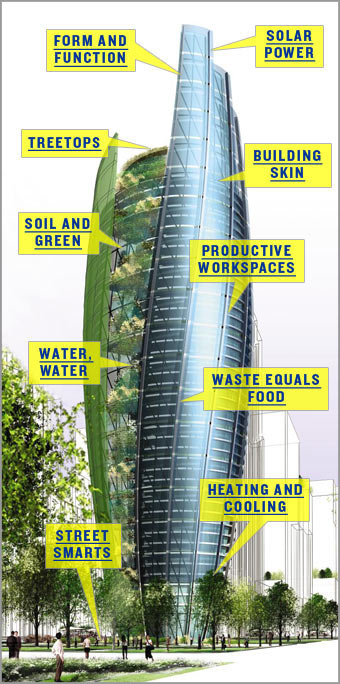
When Fortune invited my design firm, which specializes in sustainable architecture, to share our vision of a building of the future, we decided not to guess about conditions decades or centuries away. Instead, we looked at the possibilities that exist now.

Buildings consume 40 percent of our energy and can have life spans longer than humans. Because we live, work and associate with others in buildings, they form part of the fabric of human life—and thus have an enormous effect not only on the quality of individual lives but also on the state of the earth.

In the pages that follow, we have configured a structure that is not just kind to nature; it actually imitates nature. Imagine a building that makes oxygen, distills water, produces energy, changes with the seasons—and is beautiful. In effect, that building is like a tree, standing in a city that is like a forest. -- By William McDonough, founder and principal of William McDonough & Partners

Thursday, October 18, 2007

Building the future: Chicago architects envision what the city will

Giant windmills, floating skyscrapers and an "elevator to space" in Lake Michigan. An automated 64-lane superhighway in the center of Chicago. Navy Pier reinvented as a year-round farmer's market. A system of underground tunnels through which people travel throughout the city and state. A network of water-recycling "eco-boulevards." Houses made of bioengineered trees. u These were among the mind- bending ideas for what Chicago might look like 100 years from now, presented as part of "The City of the Future: A Design and Engineering Challenge," a competition of local architectural teams held last month at the Chicago Architecture Foundation. Sponsored by the History Channel (as an offshoot of "Engineering an Empire," a series that examines architectural and engineering marvels of the ancient world) and other groups, the contest featured eight teams that were given a week to envision and create presentations for the city in the year 2106.

The winning team won $10,000 and the right to compete in a national round next month against the victors in similar competitions in New York and Los Angeles. Starting Tuesday, the winning projects will be previewed on the History Channel's Web site (www.history.com/designchallenge), with visitors to the site invited to vote for their favorites. The team receiving the most votes will win an additional $10,000 and be named the National City of the Future. Guiding the process will be a jury led by architect Daniel Liebeskind, designer of the Ground Zero master plan.

Paris gets new architecture show
Casts of sculptures on show at Museum of French Monuments
Some of France's finest religious sculptures are on show
France will celebrate its rich architectural traditions this weekend with the opening of a major new museum in the heart of Paris.

The Museum of French Monuments spans 800 years of French architecture. It is housed in the east wing of the Chaillot Palace, opposite the Eiffel Tower.

The exhibition occupies three galleries, spread over 8,000sq m (86,080 sq ft).

It includes plaster casts of church facades and copies of vast murals.

Numerous models are also used to explain the development of French architecture down the centuries.

"We are showing a history of French architecture from the 11th Century to the present day," said the project's director, Francois de Mazieres. "We didn't want any break between old and modern."

The exhibits include a reproduction of a futuristic 20th-Century Le Corbusier apartment built in Marseille. The original is regarded as one of the architect's masterpieces.

The museum project - called the City of Architecture - was launched in 1994. It suffered delays and budget problems, leaving a final bill of 80m euros (£55m), the French daily Le Monde reports.

Sunday, October 14, 2007

Building the future: New possibilities for thin films in building integrated PV
Silke Krawietz

Silke Krawietz summarizes the outcome of her research project on behalf of UNESCO that explores the future architectural potential of building integrated photovoltaics (BIPV), in particular thin film PV technologies. The project combines the interests and motivations of architects and of solar researchers and manufacturers. Exploration of the characteristics of thin film technologies currently on the market and the kind of technology that high-profile architectural projects require formed the basis for the scientific research.

The rapidly growing importance of renewable energy technologies, in particular PV, makes them a critical focus for research. So far, wafer-based PV technology has been the industry standard, while thin film technology, which uses polycrystalline silicon film deposited on low-cost substrates, particularly glass, is already available in the market. Research to improve thin film technology continues. The most important research recently conducted has been helping to allow technology to transition from the first-generation, based on silicon wafers, to the second generation, in which a low-cost substrate supports thin films, as in the case of polycrystalline silicon film on glass. The wafer-based approach requires material in quantities that limit the potential for cost reduction and, hence, the long-term impact of the technology. It is expected that a mature second generation will replace first-generation technology over the coming decades. The change to thin-film dominance is considered inevitable, even though demand for first-generation technology will still remain. The advantages of second generation technologies include the lower price of modules and a more pleasing appearance. It is, for example, possible to produce semitransparent thin film modules (as is the case with first generation technology).

The integration of photovoltaics in buildings is a key to the future of PV technology. Architects and engineers are willing to integrate PV into their overall design projects and concepts. We know that architects are restricted to selecting PV technologies that are on the market. Further research into building integrated PV is also required to achieve the aims of architects and designers, which is to enhance the use of this technology in their buildings. The increased use of this technology in building integrated PV (BIPV) and research into thin films is expected to be ongoing in the medium and long terms to reduce the costs of the technology in such applications.

For thin films, high efficiency is the key to reducing the cost per rated watt of product in the long term. Third-generation PV maytriple efficiencies and hence significantly reduce costs of thin-film cells and modules.

BIPV potential

The possible uses of thin film PV in BIPV are wide ranging. And what important architectural and engineering characteristics must it have to make it suitable in BIPV? As the efficiency of thin-film cells continues to rise, their flexibility of use in BIPV will increase, making them a great asset. PV researchers are aiming for greater efficiency. Architects want to use PV in new applications and integration methods and want PV modules with improved aesthetics for specific projects. The solar industry is looking for cost-effectiveness in PV.

The needs of BIPV

What module and design features would high-profile architects find attractive in second-generation technology, and what further development would be required to make it even more financially competitive? What is the potential for large-scale application and building integration of the second generation of PV? The costs of thin-film technology make it more competitive with standard building materials. Table 1 summarizes the characteristics of first and second generation PV technology.

Click here to enlarge image

Desired characteristics

A summary follows of the main points that high-profile architects and engineers made in this research about how the development of PV modules should progress, in particular thin-film modules, and about what characteristics they would like to see in BIPV:

  • More variation in colour of and pattern on PV modules.
  • In the design of PV modules, more flexibility in the shape and dimensions of semitransparent panels. This would give architectural projects the opportunity to use PV in a greater range of applications.
  • Higher efficiency is needed for large-scale use.
  • More information about and the common development of new products is desirable. Interdisciplinary collaboration by architects, engineers and the PV industry on new products and the photovoltaic characteristics of PV panels that are under development - and research into them - might be the key to creating inventive applications in architecture and might enlarge the market for BIPV significantly. Some architects have criticized the nature of the available information about the potential of existing products and their ranges of applications.
  • Reduction of PV costs is essential for the expanded use of BIPV in high-profile projects. This is the main argument for enhanced BIPV use in architectural projects.
  • Life cycle assessment should be improved. Products should be more durable and have fewer technical problems over the 25 years that is typical of their operating lives.
  • Enhanced interdisciplinary research in collaboration with the PV industry into new PV products and modules (their design, characteristics, colours, patterns, new forms of integration) is needed. This has not yet happened to a great extent between architects, engineers, the PV industry, PV researchers and PV designers.
  • Greater BIPV variability from the PV modules side. This would increase the integration possibilities of the products.
  • Better collaboration in the field of legal standards for the integration of PV modules and products (standards for safe integration of glass and PV modules).
  • Reduction of the energy losses incurred through problems in storage, through inverters and through inaccurate planning of the integration (for example shadowing of modules).
Overall results of the project

The project has found that high-profile international architects and engineers and the leading research institutes in the field of PV want to see further development of second generation photovoltaics in BIPV that will introduce new design features and technical characteristics that will make them competitive materials to use by the PV production industry.

The project aimed to explore the potential for architectural application of new PV technology. It also aimed to exploit technology developed at the Centre of Excellence for Advanced Silicon Photovoltaics and Photonics at the University of New South Wales in Australia, under the leadership of Professor Martin A. Green. It also aimed to integrate its findings into the university’s teaching programme and support education for sustainability in the medium and long terms.

The project and it’s results can be directly integrated into technology education and the teaching sector. The outcome can be made available to a large number of engineers, architects and scientists through the connection with UNESCO and other related international programmes.

Further results

Exploration of the potential use of second generation, thin film photovoltaic technology in architecture has not yet been explored in the field of BIPV from the point of view of architectural expectations of this technology. The results of the project show how innovative it was and underline the importance of interdisciplinary collaboration between architects, industry and engineers. It shows that further development and detailed research is needed into the use of thin film PV technology in BIPV, and into what new design features it should have based on the needs of international architects and engineers. There should also be analysis of what steps have to be taken to make this technology competitive on the market.

Dr Silke Krawietz is Interim Professor at the Faculty of Architecture, University of Catania, Italy, and a teacher. She is also a specialist in BIPV, in the newest PV technologies and in renewable energy in architecture and engineering. She will soon publish a manual about BIPV for architects and engineers. She has various roles at the Italian Industry Association, including speaker and advisor on energy efficiency and on the use of renewable energy in buildings.
e-mail: seta@gmx.net


Background to the BIPV research project

The architects that took part in the project included Foster and Partners; PTW-Peddle Thorp and Walker Architects, and Alberto Breschi. The engineers included Battle McCarthy and Arup.

In various meetings, overall ideas were explored, including selected reference projects of the various architects (planned, ongoing and past projects), projects that use first generation PV and second generation PV and a planned large-scale project, the Beijing Olympic Swimming Centre.

Part of the project included a meeting of high-profile architects, engineers and industry partners in London. Participants were the author and representatives of Richard Rogers Partnership, Battle McCarthy Engineers, BDSP Engineers and industry representatives from Schott Solar of Germany. The topics discussed included the architectural potential of thin film PV for BIPV.


Endesa headquarters

A good example of first generation BIPV integration is in Endesa’s headquarters in Madrid, Spain, designed by architects Kohn Pederson Fox and engineering firm Battle McCarthy. In addition to an overall eco-friendly design, the project contains photovoltaics in the glass roof of the huge atrium.

Integrated design measures have been taken to reduce the building’s dependence on mechanical systems and extraneous energy use. An ambitious efficiency target has been set of 30% reductions compared with a normal building of this size. The 4600 m2 atrium roof has been designed to receive standard sized, semitransparent PV panels progressively procured during the building’s life up to a potential 4600 m2 of panels.


BIPV used in the roof of the atrium at Endesa’s headquarters in Madrid, Spain


External view of Endesa’s HQ battle mccarthy, © kohn pederson fox architects


LA courthouse building

The Los Angeles Federal Courthouse integrates thin film photovoltaics. The architects and chief engineer Battle McCarthy incorporated eco-friendly features into the initial design of the building so that it could serve as a landmark in sustainable building. The building was oriented so that a large PV system could be placed on the south wall. A ground-source heat pump system in the foundations will provide cooling. Internally, the design of the central atrium allowed natural ventilation and daylight for the courtrooms and public spaces. Perkins & Will designed the building, which in 2003 received the Architectural Review Future Project Prize MIPIM.


BIPV integration into the facade of the Los Angeles courthouse © perkins & will architects


Railway station for high-speed trains in Naples, Italy

Another recent project that is using BIPV is the station for high-speed trains in Naples, Italy, designed by Zaha-Hadid Architects in collaboration with Max Fordham Engineers. Construction will end in 2008.


Internal view of the station for high-speed trains in Naples, Italy © zaha-hadid architects


Beijing Swimming Centre for the 2008 Olympics

The Beijing 2008 Games aquatic centre aims to meet international standards for competition while maximizing social and economic benefits. The centre will provide public multi-function leisure and fitness facilities before and after the games. The design aims to make the building visually striking, energy efficient and ecologically friendly.

Integration of PV into the building had been planned but had to be abandoned because the characteristics that the architect PTW and engineer Arup wanted from the PV technology and the construction material, such as the desired semitransparent effects and the thermal properties of the construction material, could not be met by available technology. Even in this modern high-technology project in which the client looked favourably on renewable energy and in which the newest building materials were used (such as high-tech EFTE cushions for cladding the building), the PV technology was unable to match the characteristics needed for it to be integrated into the project.


Watercube, Olympic Swimming Centre, Beijing © ptw architects, sydney, australia

Friday, October 12, 2007

ArmyTurner Team Wins $448M Contract to Build Army Campus in Maryland
Having submitted a bid as part of a joint venture, Turner Construction Co. has been selected by the U.S. Army Corps of Engineers to handle design-build responsibilities for a new high-tech office and laboratory complex at Aberdeen Proving Ground in Aberdeen, Md. The contract for the 1 million-square-foot project is valued at $447.5 million.
Trump Trump Announces International Strategy with New Hotel Collection
The world is Donald Trump's oyster, and he has found the pearl in the growing international hospitality market.

Thursday, October 11, 2007

CURRENTS: MATERIALS; From Architecture Students, A Sculptural Structure of Polycarbonate


By ELAINE LOUIE
Published: September 28, 2006

Last month, architecture students at Georgia Institute of Technology in Atlanta, led by their professor, Nader Tehrani, top right, installed a transparent, undulating, sometimes gleaming, sometimes misty polycarbonate structure, top, outside the school's architecture building. The $70,000 installation was the result of a year's research by the students on transforming flat polycarbonate into three-dimensional structures.

''It's a sheet material, but because of its pliability, it has the ability to bend and twist,'' said Mr. Tehrani, a partner at Office dA, a design firm in Boston. He and the students started with a seat, he said, and ''grew the structure out of that.'' At its base, top left, the piece, which is held together by small rivets, looks like stacked horizontal ribbons and functions as a bench. As it rises, right, the ribbons twist into a series of four-sided openings before coming together to rest on top of an existing concrete beam that helps frame the entrance to the building. ''It rotates out and creates this bubbly effect, almost like it fizzles open,'' Mr. Tehrani said.

''It's a physically inert object, but it's incredibly dynamic,'' said Chris Jarrett, the acting director of the university's architecture program. ''On a bright, sunshiny day, it becomes lighter and more reflective,'' and if someone wearing a red sweater stands near it, ''a little bit of it looks pink.'' The institute is at 247 Fourth Street in Atlanta; coa.gatech.edu/arch.
Opening October 12th 6-9pm
part of the Silver Lake Art Crawl X.
Music to be spun by Steve Nalepa

Opening October 12, 2007, an “extreme cantilever” built from aluminum and polypropylene rope will hover over the courtyard of Materials & Applications (M&A) in Silver Lake, Los Angeles. This structure is an outdoor installation created by Sci-Arc professors Dwayne Oyler and Jenny Wu, called Density Fields. Defying classification as either sculpture or architecture, the piece will flex with a gesture that extends imaginary lines of force beyond the small courtyard, seeming to pierce buildings and features in the neighborhood.

The primary structural question Oyler-Wu Collaborative asked is, "What makes the idea of using lines different in terms of their structural properties?" The idea addresses tensile properties, thereby limiting the structural possibilities, but also allows for a more specific way of designing that exploits tensile strength. This line of inquiry led them to a structural principle that utilizes a dense field of lines. The installation consists of two basic materials: (1) an aluminum frame extending up from the ground and out into the space, and (2) a series of fine, tensioned cables pulling the cantilever in the opposite direction -- forcing it to hover above the ground.

The development of this piece began with the imaginary violent attack of the bristling sculpture on the neighboring buildings, then with careful editing of the geometrical elements, the sculpture retracted back to its tensed position in the M&A courtyard. Oyler-Wu Collaborative's goal is to negotiate the structural ideas, the programmatic needs of the space, and the desire to use basic geometries to create a rich spatial experience within the space itself. With the help of engineer Bruce Danziger from Arup LA and many volunteers, the piece will be another traffic-stopper in the Silver Lake neighborhood.

Artists

Density Fields is designed by Oyler Wu Collaborative (Dwayne Oyler and Jenny Wu) and engineered by Bruce Danziger of ARUP.

Extra special thanks to all the skilled volunteers already involved and all the rest who will join in the coming weeks, if you would like to join, contact us.
Astrid Diehl, Nick Blake, Nico Machida, Ji Byeon, Peri Shefik, Libby Mcinerny, Glen Kinoshita, Jim Rosenthal, Orn Sveinsson, Taylor Arneson, Paul Adam, Daniel Mas, Nick Pardowski, Martin Chow, Chris Crotty, Joshua Tremblay, Oliver Liao, Paul Macherey, Cory Hill, Jian Huang, Harold Portillo, Sky Milner, Justin Oh, Janica Ley, Joenna Kim, Abbey Chong, Jordan Su, Jon Wimmel, Adam Grove, Scott Chung, Elizabeth Marley, Emmanuel Gonzalez, Josh Avina, Todd Davis, Sven Altmetz, Daniela Morales, Luke M Stepleton, Grace Wu, Julia Dole, Sharon Ko, Nicole D. Garcia

Tuesday, October 9, 2007

solar power

Solar house takes on a temporary resident to test its livability

1/30/2007 - A house powered entirely by solar panels in the Commonwealth of Virginia has a new temporary resident: a state senator. State Sen. Frank Wagner, Virginia Beach-R, moved in on January...
energy efficient homes

Some home builders shifting towards more energy efficient homes

10/3/2007 - Demand for homes built with an eco-friendly design is steadily growing, according to architect Michelle Kaufmann, founder of home design company Michelle Kaufmann Designs (MKD). MKD, founded...
AMB London AMB Moves into London Market with Purchase of 320,000SF Industrial Project
San Francisco-based AMB Property Corp. has just made its first foray into the United Kingdom. with the acquisition of a 320,000-square-foot industrial development in London. The two-building property, AMB East London Distribution Park just reached completion.
staircase
341 NEW LOOK 2002
staircase caterpillar shoes elevation
On the corner of Oxford Street and Portman Street, double height yellow glass panels are opened to reveal the entrance into New Look’s flagship store. An elegant stainless steel stair leads you to a dramatic warehouse space on the first floor, framed by pink tinted windows. A coloured and reflective caterpillar of light divides the store between an extravagant gallery area with seating and café and a more densely arranged retail space. Suspended figure drops display the latest fashions and a series of white perspex cubes contain a volume of merchandise.
Completion
Contract Value
Area
Client
Structural Engineer Services Engineer
Quantity Surveyor
Contractor
2003
£2.4 million
2000m²
New Look
Techniker
Ernest Griffiths + Son
Faithfull + Gould
TTS Interiors

Saturday, October 6, 2007

model aerial view
377 MASERATI MUSEUM 2004
model aerial view model profile view internal view aerial view
The Maserati Museum nestles in the grounds of the turn of the century Enzo Ferrari house in Modena, Italy - a submerged, soft blue form appearing to grow out of the surrounding landscape. The house being modest in scale has determined the height of the museum. A vast wall of curved, inclined glass draws you into the space, the curved plane bisected by fins inspired by the radiator of a Maserati. North facing roof lights flood the interior volume with diffused white light. Inside the walls and floor of the museum, rectangular in plan, forms a basin, finished in fine white terrazzo. This strong and embracing space provides the perfect environment in which to display the achievement and finesse of the Maserati collection.
Completion
Contract Value
Area
Client
Concept Engineer
Engineer
Quantity Surveyor
2009
£7 million
4,500m²
Fondazione Casa Natale Enzo Ferrari
Arup
Politecnica
Politecnica

Wednesday, October 3, 2007

model
407 NATIONAL LIBRARY PRAGUE 2007
render model render render

The New National Library of the Czech Republic is situated within a large green site on the Letna plateau in Prague.

The 40.000 sqm building is placed on a white unpolished marble platform, with mirror finished stainless steel wings lifted up the perimeter edges to reflect the building from different angles.
The architecture of the proposed building is a three dimensional object shaped to minimize the volume and to extend the views over the surrounding tree level. Its unique form and curvature is a reference to baroque buildings in Prague.
The skin is covered with champagne coloured anodised aluminium tiles fading from dark at the bottom to light at the top. Generous levels of natural light in all public spaces are provided by circular areas of glazing distributed over the external skin. Special features inside the building include the top level viewing platform and café with spectacular vistas over Prague, comfortable and colourful reading rooms, the first level ‘street’ which continues the public realm through ramps and stairs from the street and park inside the building, and the educational viewing well to the automated book storage. The estimated volume of 10 million books stored underground are distributed by an Automated Storage and Retrieval System and reach the reader in less than 5 minutes. At the day of its completion in 2011, the New National Library of the Czech Republic will be one of the most modern Libraries in the world.

Client The Czech National Library
Architect Future Systems
Structural Engineers Ove Arup
Quantity Surveyors Savant International
Artist
Vaclav Cigler
model
135 BLOB 1985
model photomontage isometric elevation
Competition proposal for an office building on the grand buildings site of Trafalgar Square.
The curved geometry is a product of the site plan and setback angles. An extensive pedestrian area is located at street level together with shops, a restaurant is located at roof deck level. The building structure comprises a dual 3-dimensional internally stiffened skin which fully encloses the building from street to roof deck level. The structural skin supports a deep truss roof deck which provides suspension capability around the perimeter of the inner edges of alternate office floors using hangars. Additional intermediate floors are suspended from the alternate floors.
Large circular windows perforate the skin at intervals to provide view and outside contact. The surface is finished in white ceramic tiles with recessed rainwater channels. Photovoltaic cells can be integrated into the exterior wall to help supply the building energy needs.
Structural Engineer Frank Newby/Samuely & Partners